
STAGES OF LABOUR
In addition to the official stages of labour we will go through in a moment, many birthers experience “prodromal” labour. This used to often be called false labour, but there’s nothing ‘false’ about it. These contractions feel real, stronger than braxton hicks and are an indication that your body is warming up and practicing for the big day. Prodromal contractions will be different in that they will not get closer together, longer or stronger (all things that will happen during your first stage of ‘true’ labour)- they will be unpredictable and often stop as quickly as they start. Sounds fun, right?
Prodromal labour can be disheartening, but perspective is everything- your body is working! And this can be a great opportunity to practice some of those labour coping techniques to get an idea of what will work for you.
Stages of Labour
First Stage
Contractions build and your body works to dilate your cervix and move baby down.
Second Stage
Pushing and birth of baby!
Third Stage
The most forgotten stage, this is when your body delivers the placenta.

The First stage of labour is further broken down into three parts: Early Labour, Active Labour, and Transition.
First Stage: Early Labour
Contractions have started, it’s here! Time to start those coping techniques and settle in at your birth space, right? Not quite.
A lot of first-time birthers are excited for it to hurt, because that makes it real and means baby will be here soon. But contracting does not equal active labour, and the truth is that the longer you can ignore those rushes and discomfort, the longer you can ‘do life’ and the less time overall you’re going to spend in that ‘labouring’ state of mind. It’s so easy to get caught up in the excitement of those early rushes, but remember that labour is a marathon and not a sprint! Early labour can be long and drawn out, reaching 6-24 hours (or more!), especially for first time birthers.
Contractions during early labour can be anywhere from 5-20 minutes apart. (Tip: Time contractions from the very start of one, to the very start of the next, not the time in between). You know it’s early labour if contractions are progressing closer (not sporadic), but you are still able to focus on life, carrying on a conversation even, pausing only during the height of a contraction, and are able to relax completely in between contractions. They may be 30-60 seconds long. This stage of labour is when your cervix goes from 0-5cms, and can sometimes take a while! Your body also works on thinning out your cervix (effacement), and moving it from posterior to anterior.
Doing Life
While there is important work being done during this time, it often doesn’t feel like it. Watching the clock can make time seem to stand still, so I recommend “doing life”. That is— continue to go about your day as you normally would, stopping just long enough for the contraction to pass, and then brushing it off and continuing on as normal. The longer that you can deny labour and keep doing life, the better headspace you will probably be in once active labour hits.
How your labour progresses will depend SO much on your mental state going in. Preparing yourself well during these early hours can make a crucial difference to how you feel once you’re hitting active labour and transition.
Picture an early labour with contractions that are 6-8 minutes apart and 45 seconds long, lasting for 15 hours. You have two options- spending those 15 hours napping, nourishing your body with good food, watching guilty pleasure tv and going for a walk with friends- or you can spend those 15 hours with a stopwatch sitting on a birth ball, paying attention to every single time your uterus tightens. The first would put you in a much better headspace, right? You’ll want to be in that relaxed state heading into active labour.
Early Labour Ideas…
Sleep! In early labour my first priority is always rest if you can
Take a long leisurely shower or bath (If contractions stop it means it was probably prodromal labour)
Make food, or bake! This can be relaxing and keep your focus off of the rushes
Play a game with your partner, family or friends
Cuddle on the couch with a blanket and your favourite Netflix series. Bonus points if it’s sappy or makes you laugh
Clean your house - slowly though. Don’t burn extra energy you don’t have to!
Go shopping! It seems weird, but the movement, change of scenery and distractions are all good
Take a walk around your neighborhood
Grab your phone and take a last set of belly photos
If you think you may be in early labour, send me a quick message to let me know— and then continue business as usual. Use one of the tips from this list, or pick something of your own. The important thing is that the activity keeps you comfortable and focused on anything other than your beginning contractions!
It can be helpful to time your contractions for 30 minutes or so, but then put the app away for a while. You do NOT need a constant log of your contractions- just to be able to tell when they are changing- and your body will likely be able to tell you this as well. I linked my favourite contraction timer in your third trimester prep list - it allows the option to send the link to me so that I get a ‘livestream’ of your contractions as you enter them, without you having to continually pay attention, screenshot and send them over. Do what you can not to become too focused on the clock. When things feel like they’ve shifted, pull out the app again and log for a bit and then put it back away.
Once you find that you are having to stop and really focus through your contractions while using your coping tools, or they are four minutes or less apart and a full minute long, it’s time to call your doula again (and your midwife if need be!). Start thinking about moving to your chosen place of birth if not planning a homebirth, and getting settled in to meet your baby!
First Stage: Active Labour
You are typically considered in active labour once contractions have progressed to being 4 minutes apart or less and over one minute long for longer than one hour. Many providers now go by dilation instead, where 5-6cms is considered active labour. The good news is that from this point on, dilation and progress is normally quicker!
If you can hold off on really focusing on labour until this milestone (or close to it), it will make a huge difference in your emotional state. While the time from 0-5cms can take quite a long time for some birthers, typically, once you hit the 5-6cm mark, your body is in more of a groove and will continue to progress at a faster speed. Think of it like the second half of pushing a boulder up a hill - now we’re on a roll and just need to stay out of our own way! Active labour can last anywhere from 1-12 hours, but on average, active labour lasts around 5 hours.
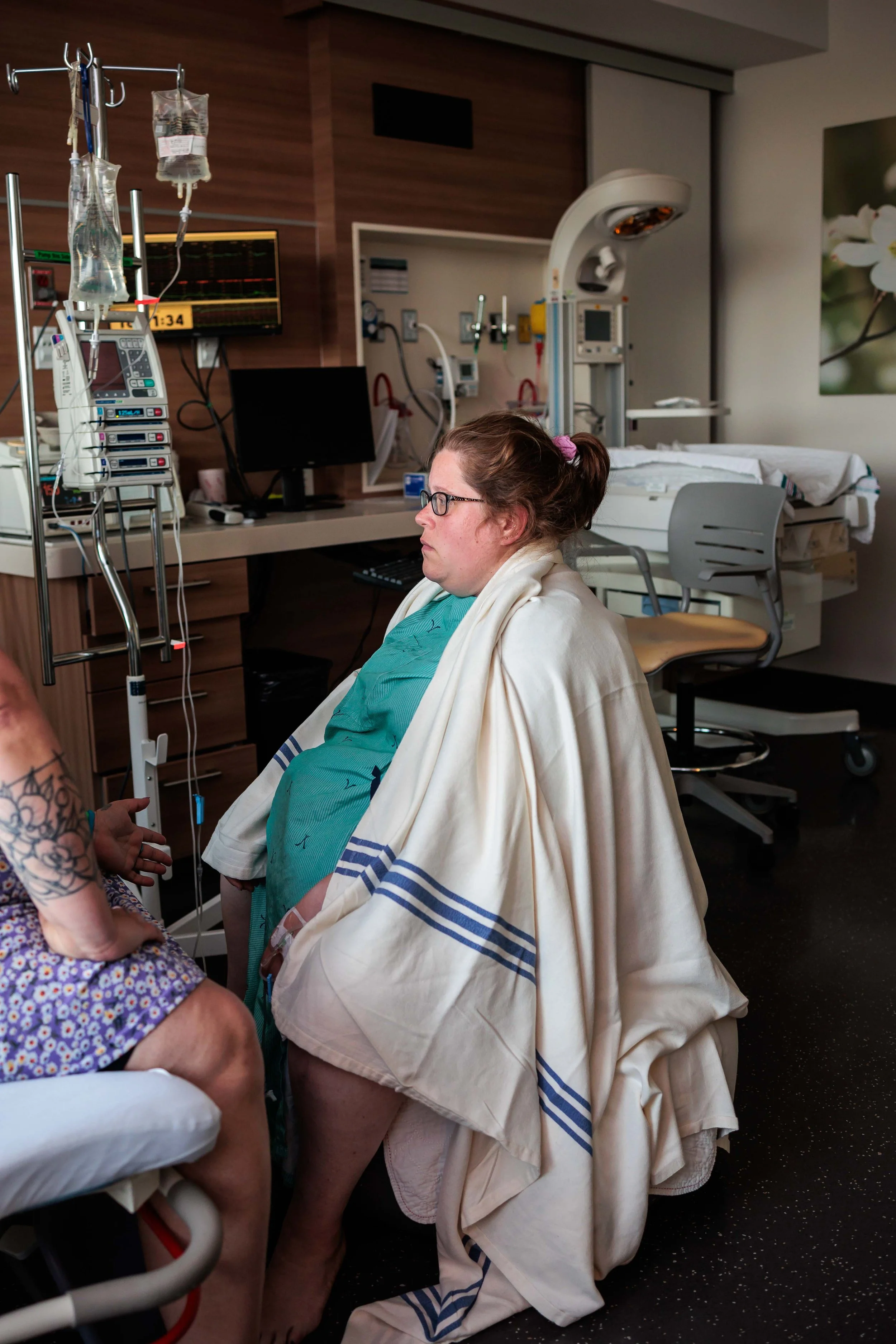
Birthers during active labour tend to exhibit the following signs:
Complete silence or needing to vocalize during contractions. (Find your rhythm!). Remember that low sounds relax your pelvic floor, while high sounds will tighten
Less likely to be engaging and talkative in between contractions. This is generally where jokes stop being funny and eye contact can be very important
Contractions between 2-4 min apart (if you’ve already had a baby...this number is less important)
Contractions lasting 60 seconds or longer (These are considered cervix changing contractions)
Bloody discharge and mucus
May need movement and to keep changing positions
Water may break if it hasn’t yet
Active labour is when you will be pulling out all those coping techniques that you’ve learned. Keeping upright and changing positions is one of the best things that you can do, and thankfully this can be done even if you’ve opted for an epidural!
Your support people should remind you to take a sip of water after every contraction, and to use the bathroom once every hour.
Active labour is a fantastic time to try out water coping methods that may be available to you- jump in that tub or shower. The combination of the warmth, the light bit of counterpressure, as well as the privacy and added white noise can all be a great comfort to our mammalian brains!

First Stage: Transition
Transition is the last part of active labour. During transition, there is no doubt that baby is coming soon. This is the most intense part of labour and is typically considered progress between 8-10cms. Transition may last 30 minutes to 2 hours, shorter if this is not your first birth or longer if baby is positioned funny or your cervix is dilated unevenly.
There is a hormonal shift during transition, urging your body towards stronger, more powerful contractions that will work to push baby down and out.
During this time birthers often vocalize loudly during contractions and then are very quiet in between. It is common to throw up and to start shaking uncontrollably, as well as feel overheated. Many also start to feel pressure in their rectum which can feel overwhelming. It is worth noting that this stage typically progresses much faster in a birthing person who is upright and moving, so make gravity your friend!
Physical
During transition baby often makes significant progress in moving to a lower station. This can feel overwhelming as the pressure in your pelvis and rectum changes, and it’s really common to want to try to ‘move away from’ the pain.
This is a great time to work on your J breathing in order to make sure that you’re not tensing up.
Movement is also fantastic during transition and serves two purposes - it prevents tension from building, and it keeps your pelvis fluid so that babe can navigate it properly.
If you haven’t already, you’ll often start to vocalize during transition. This is good - don’t fight it! Remember that low noises work to open up your pelvic floor, while high notes will increase tension.
If baby is quite low you may feel a strong urge to push, even if you are not fully dilated. Use your breathing techniques to let your body do the work it needs to do without adding additional pushing efforts until your care provider gives you the go ahead. Trust that if your body is very ready, it will push anyways, even without you. In the meantime, resist the urge.
Transition signifies the grey area between the last bit of dilation progress and the beginning of pushing. But it’s also a transition of emotions. At this time many birthers find themselves getting emotional or overwhelmed as the sensations really intensify. This is the really ‘dig deep’ part of labour and you have two main jobs:
Emotional
Transition is the time of “I don’t want to do this anymore”, “Let’s go home”, and “I think I’m dying!” You may express fear or doubt and need to be reassured that birth is progressing as it should. Even if you’ve had no reason to doubt it before, the new sensations may make you worried something is wrong. Make sure that your support person is prepared for this and knows how to calm you, rather than join your fear.
It’s common to feel out of control, even if you’ve been handling the sensations of labour well until now. This is normal. If you feel overwhelmed, remember that you can start fresh on the next contraction and all is not lost.
It can really help to be ‘grounded’ during labour - have your partner get close to you - eye contact is fantastic! While they do this they can also model appropriate breathing or just give encouragement.
If you’ve been really in the zone until now, transition can feel like a flashing sign that life is about to change. Let yourself feel that. Have a good cry if you need. Talk about it. An emotional dump is completely accepted and even helpful!
“We can’t go over it. We can’t go under it. Oh no! We’ve got to go through it! ”
Most importantly, remember that all of the work and preparation you have done has led you here, and you are ready for this! The only way is through, so transition is a time of surrender and trusting yourself. Prepare your support person to expect this stage of labour and increase their emotional support at this time - You’re doing a fabulous job - make sure they know to tell you!
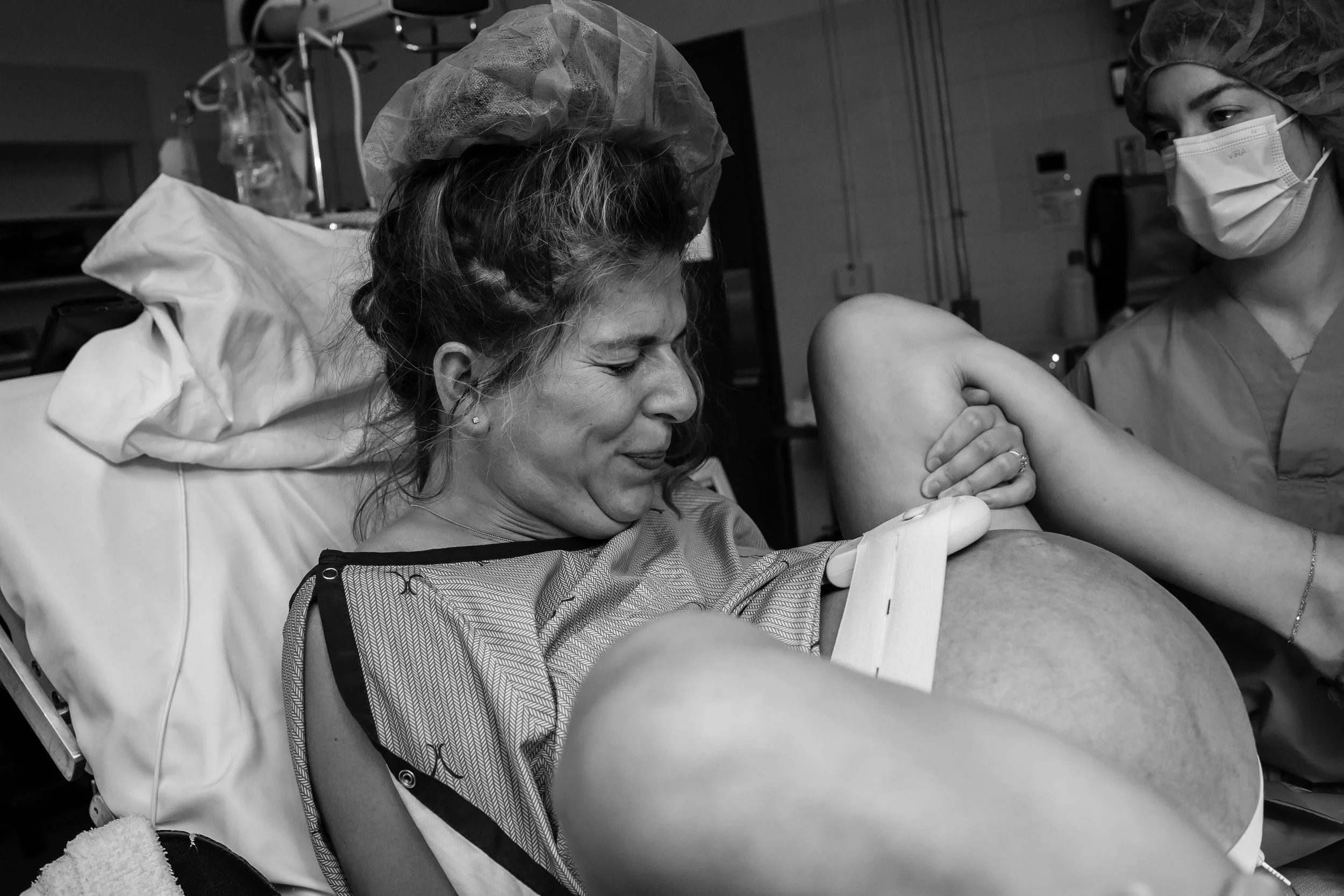

Second Stage: Pushing and Birth
Once you hit the magical 10cms, you are fully dilated. Time to push, right? Maybe.
More and more birthing people are choosing to “labour down” rather than begin pushing right away. This time allows your body to continue moving the baby down in a physiologically normal way, with you continuing to cope through contractions without pushing. This shortens pushing time, and can save a lot of energy, while allowing your body to do the work itself! If you have an epidural, you can choose to continue resting during this time until you feel a strong urge. If you are having an unmedicated labour, you can continue using your labour coping techniques until the urge to push is overwhelming. If you have had a hands-off labour and not received frequent cervical checks, it’s possible for this urge to push to come before you even realize you are fully dilated.
Once pushing begins, it may take a few hours. This is totally normal! You may also wish to wait for the Ferguson reflex (often incorrectly called the fetal ejection reflex) — which is essentially not pushing based on a predetermined dilation or time, instead waiting for your body’s instincts to take over and push baby out. This is truly a reflex in that once it starts, you cannot stop it, your body will do the work needed (with help from yourself if desired or needed due to concerning fetal tracings). In the meantime you would breathe and release, focusing on allowing your body to bring baby down. While in the hospital a typical setup involves pushing while lying reclining on the hospital bed, many nurses and providers will often encourage you to start early pushing in other positions, including out of the bed. If continuing to push in one of these positions feels best to you, don’t be afraid to say so to your provider. You have autonomy at your birth, and unless there’s a medical reason for lithotomy (pushing on your back with your knees pulled back), they should be able to accomodate you. At home or the birth centre, you are generally free to move around and push in whichever position you desire. You may wish to try multiple positions until one feels right to you, and you may try several positions during pushing as well!



For many people, pushing feels like a relief after hours of contractions. For others, it can feel overwhelming and unpleasant. Moving positions can do wonders- especially heading. to the toilet for a bit. It’s common to feel uncomfortable pushing because of worry about pooping. While this is totally normal, and yes, I promise no one cares- if that fear is holding you back, the toilet can be a good way to get past it. This is also one of the only places in life where we encourage our bodies to release our pelvic floor, so if you feel like you’re having trouble- this can be a great option to try!
It’s important to note that pushing often feels like a whole lot of nothing for quite a long time. Do not be disheartened- there are so many little signs of progress happening here, that you probably won’t notice. It often goes from seeming like progress is nil nil nil, and then all of a sudden there’s a flurry of activity around.
Once baby has moved down, your feelings will get more intense. You may feel strong pressure on your pelvic bones. The perineum will begin to bulge and before long, the baby’s scalp will become visible. Many providers will encourage a slow and steady approach to pushing at this stage to prevent tearing. The baby’s head will continue to advance with each push until it crowns. At this point some birthers wish to reach down and feel the baby’s head. This can be very empowering to remind yourself how close you are to meeting your baby! Shortly after, the forehead, nose, mouth and chin will appear. At this point, the baby’s head will turn to the side as his/her shoulders rotate into the right position for the next push. With the next contraction, the baby’s shoulders will emerge, one at a time, and then his/her body will follow. Normally if baby is healthy, he will be placed directly onto your chest for you to meet and explore. You did it!
Third Stage: Placenta Delivery
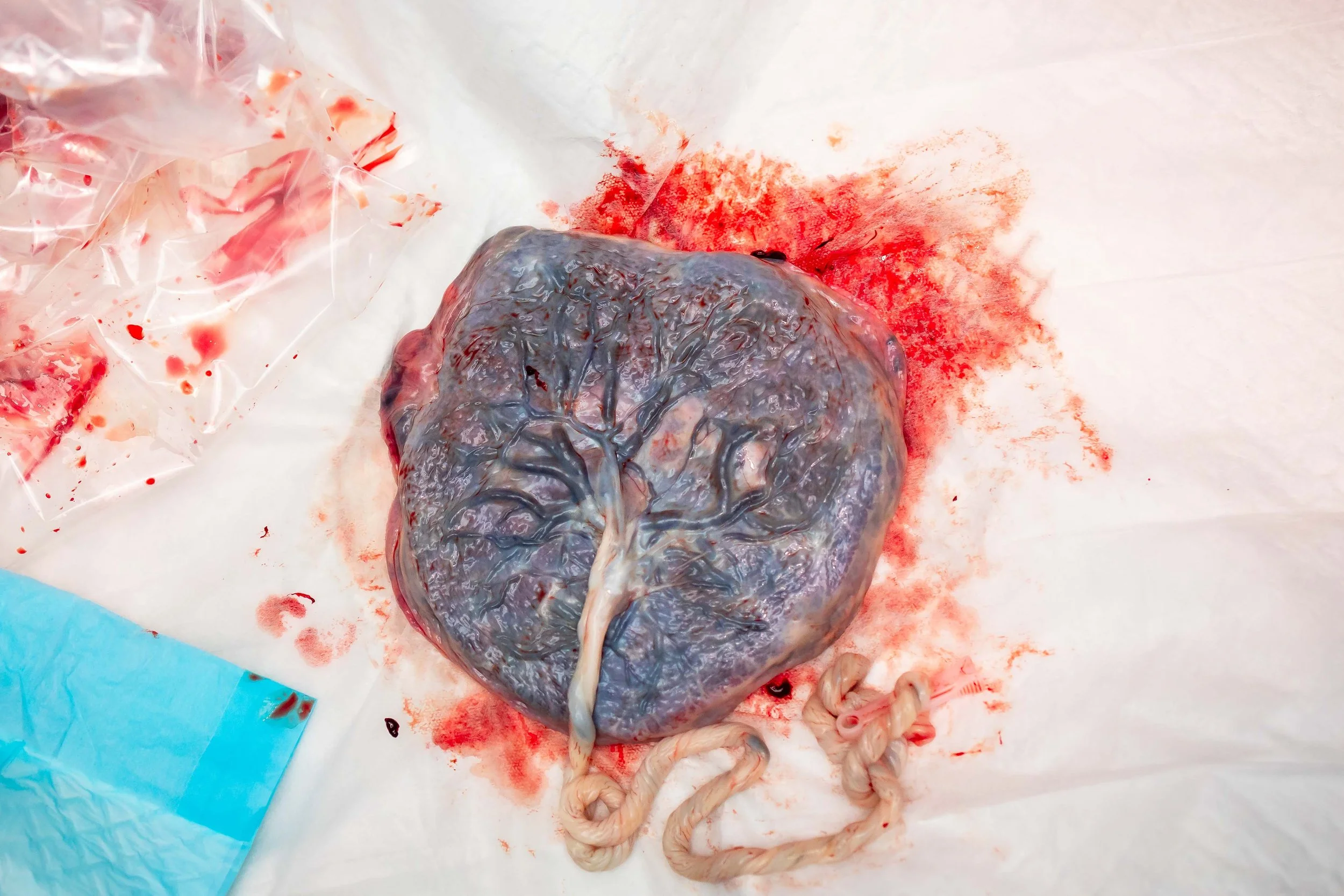
Within a few minutes of birth you will probably feel contractions start again. These begin the placenta separating from the uterine wall and out the birth canal. When you start to feel some pressure, you can often give one or two good steady pushes to deliver the placenta. Compared to the hard pressure of a baby, a placenta often feels squishy and a bit odd to push against, but the feeling doesn’t last long. It may take anywhere from 5-45 minutes to deliver the placenta.
Placenta delivery is typically categorized as Active or Expectant/Physiological management. In Active management (most hospital births), you will receive an injection of pitocin immediately post birth that will speed up separation of the placenta and allow it to be delivered quickly. Expectant management involves waiting for the body’s natural process of placenta separation. This can be encouraged with breastfeeding and skin to skin contact. While most birthing people will deliver the placenta without issue under expectant management, active management may decrease the chances of postpartum haemorrhage. Some people prefer to have the placenta delivered quickly because they felt they were able to ‘move on’ from the birth sooner and enjoy their baby, while others felt the active management made things feel rushed and hectic when they just wanted to slowly take things up. You can discuss both options with your provider, or we can go over them together as well.
If you would like to see the placenta, make sure you ask right away, as it is often removed from the room quickly. After this point your provider will assess your perineum for any tears that need repairs, and will give a local anesthetic if you do need any. This can feel pinchy, but breast/chest feeding your baby can help to distract you. If needed, you can also use nitrous oxide during these repairs to take some of the edge off.


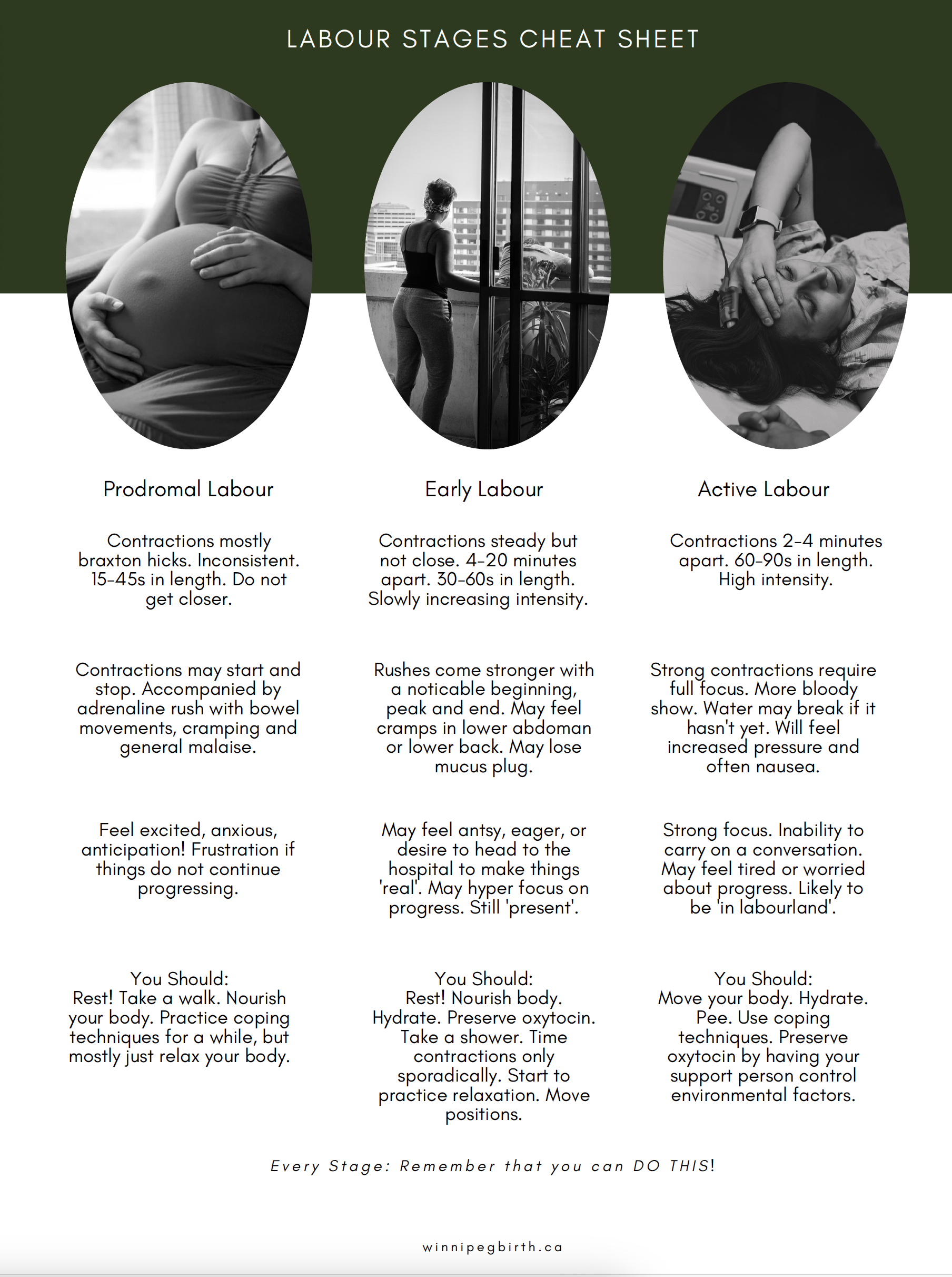
I know that can be a lot to take in, so I’ve created this handy cheatsheet to walk you through the first parts of labour. Keep it handy to reference if you’re not quite sure where you’re at during labour.