
COMFORT MEASURES

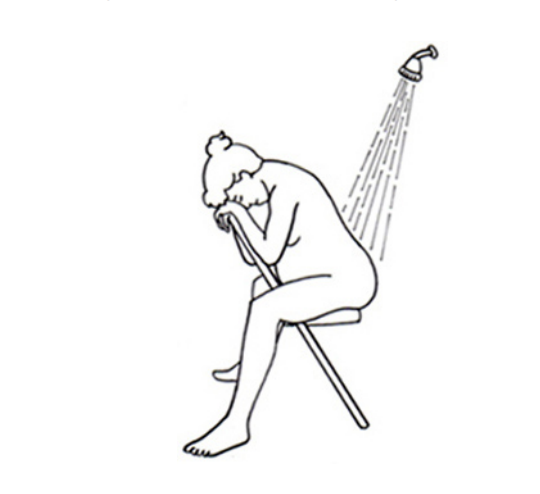
Now that we understand how birth works in a general sense, it’s time to look at what you want YOUR birth to look like. One of the most important things you will do during the prenatal period is discover the ways that you want to handle the sensations of labour. Many birthing people find that the same things that help them to relax in everyday life, are the same things that bring them comfort during labour. Think of the days when everything has gone wrong at work, you’re cranky and you have a killer migraine- how can someone soothe you in these moments? I appreciate soothing smells, warmth and massage on my head and back—and these things helped during labour too.
For you it may be some power music, dancing it out and staying loose. You may prefer a dark, silent room with little movement. Let’s explore your comfort tools- so we can use them during labour.
If you are interested in pharmacological pain relief options (Nitrous, Fentanyl, Epidural), we will go over these options as well in the next section. Having a doula does not mean you are bound to one style of pain relief- if an epidural is what makes your birth experience a positive one, I am there to support you! There is no right or wrong way to have a good birth. It is also ok (and common) to change your mind during birth, so it’s great to make sure you’re aware of all options.
Even if an epidural is in your birth plan, you will need to prepare to do at least some of your labour using relaxation and coping methods. And there is always a chance that an epidural will not take away all of the pain. We want to make sure that you’ve prepared for these scenarios so you can have a positive birth.
Take a look at the checklist of Comfort Measures below, so you can start thinking of which methods you may be most likely to use during your birth.
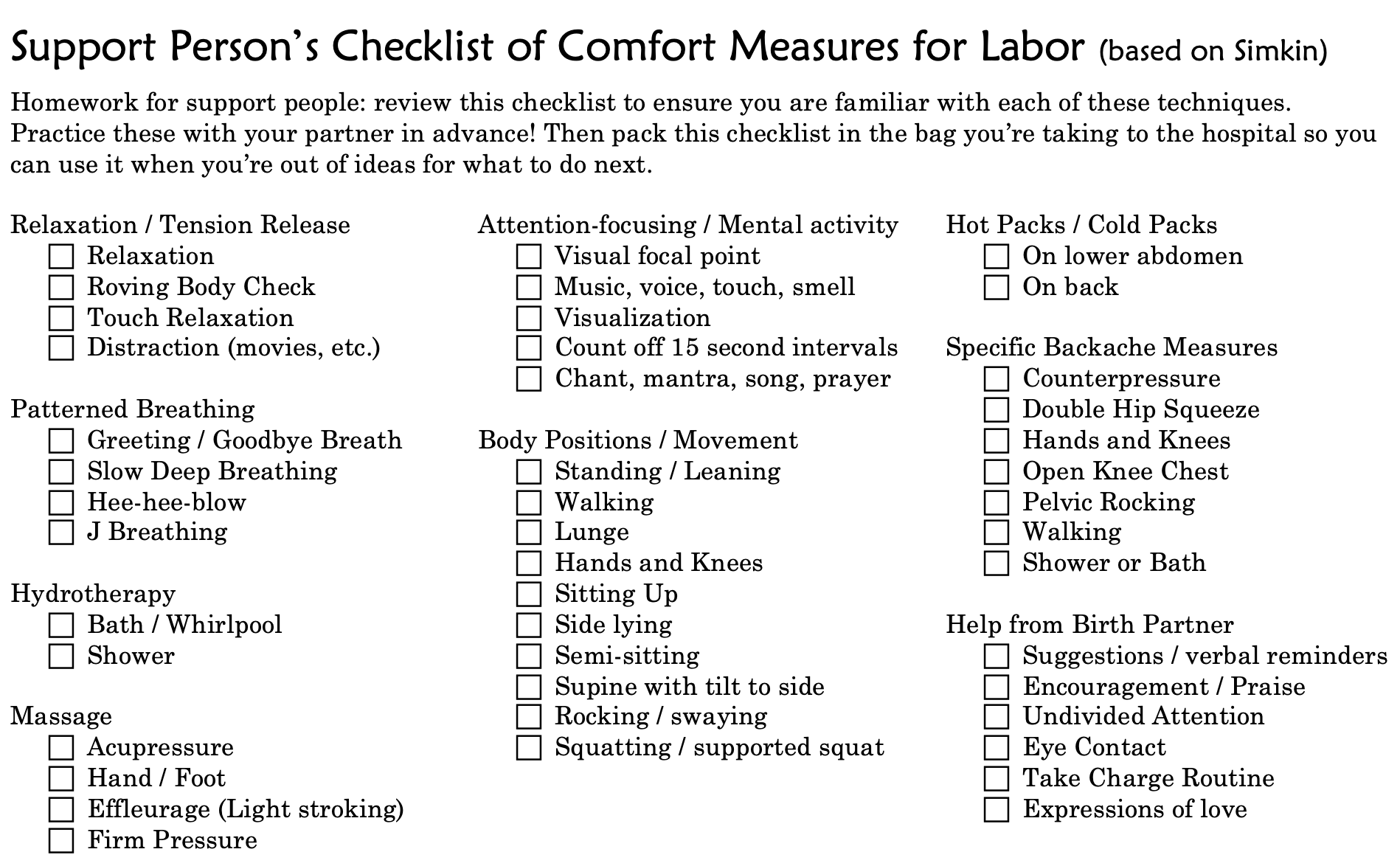
As you can see, there is a huge wealth of coping techniques that you can use during your labour. Many of these techniques seem geared towards an unmedicated labour where movement is easy. While many of these comfort measures are certainly easier out of bed, don’t mistake that for thinking a medical or bed-bound labour means that you have nothing at your disposal! Our anesthesiologists are wonderful, and most of the epidurals that I see are considered “walking epidurals” where the birther can still move around, changing positions easily. If you need to be in bed due to monitoring, you can still take advantage of peanut balls, the back of the bed, sitting upright and more. You are never without options!
In many cases, even with an epidural you will be able to get out of bed to go to the bathroom or to sit on a birthing ball beside the bed. Take advantage of this movement to stretch out your body and shake out some tension.
One of the easiest and most instinctual ways to deal with labour pain is to move. Changing positions every few contractions, moving in between contractions, or even keeping moving during a contraction can all help to stave off the pain and also to keep your body from tensing up, which hinders progress and can amplify pain.
Relaxation is not just a passive activity, but an active, conscious release of tension. Doing physical relaxation techniques which release the voluntary muscles helps to reduce physical tension, reducing pain. It also can lead to a feeling of emotional well-being and security; this in turn reduces anxiety, which reduces our sensitivity to pain.
So how does this actually come together in labour? Read on!
Muscles send messages to each other. Clenched fists, a tight mouth, a furrowed brow, all send signals to the birth-passage muscles, the very ones that need to be loosened. Opening up to relax these upper-body parts relaxes the lower ones
— William and Martha Sears

The 3 R’s in Childbirth Preparation: Relaxation, Rhythm and Ritual
The 3 R’s approach to childbirth preparation is a simplified approach based on observations of labouring people and how they actually cope with pain and stress in labour. Some cope well; others are overwhelmed in labour. There are three characteristics common to birthers who cope well:
1) They are able to relax during labour and/or between contractions.
In early labour, relaxation during contractions is a realistic and desirable goal; later in labour, many birthers cope much better if they don’t try to relax during contractions. They feel better if they move or vocalize during the contractions, or even tense parts of their bodies. It is vital, however, that they relax and are calm between contractions.
2) The use of rhythm characterizes their coping style.
3) They find and use rituals.
That is, the repeated use of personally meaningful rhythmic activities with every contraction.
At first, birthers draw heavily on the coping measures they learned in childbirth class, those who continue to cope well usually do more than that: they discover their own rituals spontaneously in active labour. If disturbed in their ritual, or prevented from doing the things they have found to be helpful, they may become upset and stressed. Birthers are most likely to find their own coping style when they feel safe and supported, and are free from restrictions on their mobility and their vocal sounds, and are free from disturbances to their concentration, such as people talking to them, or doing procedures during contractions.
Some examples:
• having hair brushed rhythmically during contractions
• Rocking in rhythm with your own pattern of breathing
• Leaning on object and swaying rhythmically side to side while partner presses on lower back
• Have a partner count out loud the number of breaths in a contraction
Once a birther finds a ritual, they depend on it for many contractions. Changing the ritual or disturbing it throws them off. Most people change their ritual from time to time in labour, when a change of pace seems necessary, but it should be their decision.
TAKEAWAY: Generally speaking, you don’t ‘fall into’ an easy birth. But we can use the knowledge that we gain prenatally in order to develop rituals that will help us to feel calm and comfortable even when labour gets intense. The contents of these rituals may look very different for each person, the important thing is finding something that is soothing to you. That’s why we examine coping techniques during pregnancy, so you have an idea in mind of what may work during the intensity of labour.
Hands On Relaxation Techniques
When we look at the different ways to cope with the sensations of labour, we can see that there are ones that fall into more of a mental/mindset category, some that are position or movement based, and others that require hands on help from a support person. We’re going to look at this last category first.
In early labour, it’s likely that you’ll do a lot of your coping on your own. As mammals, birthing people tend to seek out quiet, dark, alone spaces to help build natural oxytocin in the early labour hours. It’s no coincidence that majority of labours start during the middle of the night — this is when your body feels safe and secure. It’s very common to feel contractions start in the middle of the night and the birthing person to slip away and labour quietly in a different room or the bathroom for several hours before deciding to wake their partner. This time is sacred, and allows your body to progress labour without feeling watched.
Once things get intense though, it’s usually helpful to have another set of hands to assist your relaxation. Here’s a few ways to do that.
-
During labour, it’s wonderful if the partner can see where birther is holding tension, and touch them there to encourage relaxation. This is most effective if you’ve practiced before, and is a great way to remind the birther to release tension without having to say the dreaded “relax.” A physical reminder is often easier than a verbal one once you’re in labourland.
During pregnancy you can practice while sitting together. Tense a muscle group and see if your partner can determine where you’re holding tension. Have them touch and practice releasing that tension through their hand. During labour, your body will be familiar with the cue of a gentle hand meaning you should release those muscles. Remember that this is intended to use just touch, not massage (which we will go over next).
-
Touch fuels connection and connection reduces fear. You don’t have to be a professional massage therapist to be able to bring reassurance with your touch. Your partner or support person can offer gentle strokes on the shoulders, upper back or feet, and build to find the right level of pressure. Some people love a deeper massage even during contractions, while others prefer light touches barely brushing the skin. Experiment and see which feels better to you during labour. Even with a well functioning epidural, some light strokes up and down the length of your back while you are side lying can feel very reassuring.
-
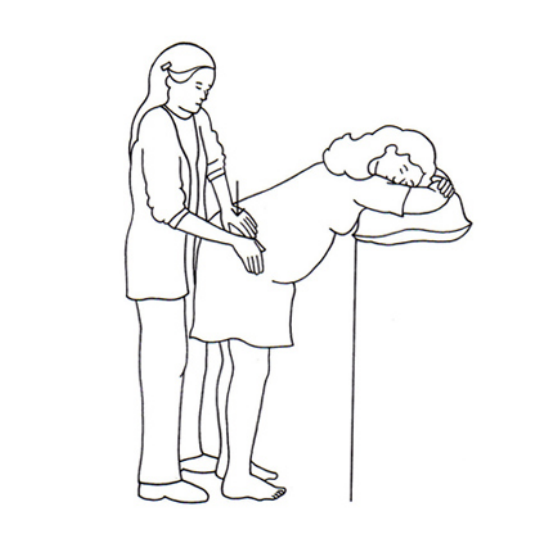
This is one secret weapon that every support person should have in their back pocket. Whether or not you experience back labour, many birthers find that as the contraction pressure gets more intense, and especially as baby makes their way lower in the birth canal, they feel a lot of tension in their lower back and hips, especially during a contraction. Offering counterpressure allows the birthing person to feel like they can relax into the contractions rather than involuntarily fighting them.
To do a double hip squeeze, the support person will stand or sit behind you, and push inwards on the hips bones, with their fingertips pointing inwards. I’ll link a video below so you can watch.
-
I find most people in labour prefer either the double hip squeeze OR sacral pressure, rarely both. So make sure your support person knows how to do both! Like the double hip squeeze, this is a pressure based move intended to release tension in the back. Unlike the double hip squeeze, you’re going to achieve this by locating the sacrum (the triangular bone on the back of the pelvis), and pressing down with the palm of your hand. This technique can be easier than a double hip squeeze since you can push your whole body into it if needed, rather than using simply arm strength.
Breathing Relaxation Techniques
Let’s be honest, when most people think about labour preparation they picture 80’s style lamaze breathing and a lot of hee-hee hoo-hoo. While this may be effective for you, preparing your breath for labour is so much more.
Using breathing techniques during labour has three main benefits:
Provide oxygen to birther and baby. If the muscles are well-oxygenated, they can function more effectively, so there will be less pain. If baby has plenty of oxygen, his heart rate will look great.
Relaxation: Rhythmic breathing promotes physical relaxation by reducing muscle tension, and promotes emotional relaxation by reducing anxiety.
Distraction: Breathing techniques provide a means for distracting the birther from the pain of labour, giving them something to focus on other than the contraction.

-
At the beginning of each contraction, take a deep breath in through your nose, then exhale through your mouth, loud enough that others can hear the exhale. It doesn’t have to have a specific pattern to it, it’s a signal both to yourself and to your support person that we are starting fresh with a new contraction. When a contraction ends, take another deep cleansing breath, perhaps also yawning or stretching to release tension.
-
This is a controlled but easy breathing style that allows you to focus on breath without putting a lot of pressure on yourself. Use this when you’re in early or early active labour and want to start your breathing techniques but don’t feel the need to be pushing tension away yet.
-
This is my preferred breathing method as it helps to push tension out of your body. Inhale slowly through your nose, allowing your belly to expand first, then your chest. Exhale slowly through your mouth. Picture the breath slowly moving down your back, and relaxing each muscle group as the breath reaches it, until you have fully exhaled, and can feel your lower back muscles relaxing and fanning out (push out the bottom of that J). Inhale again only when you feel the air ‘wants’ to come back in. Breathing should be slow and relaxed, about half your normal rate.
When to use: Use it through as much of labour as possible. Some use it for their entire labour. During transition, you will likely find you want to moan on your exhales. As long as these sounds stay low, this is perfect!
-
This is going to be more similar to the Lamaze breathing you see on tv. It’s time to switch to this breathing if you’re feeling a lot of pressure and having trouble not pushing or if you’re feeling overwhelmed and can’t keep up with the longer abdominal breathing.
In transition breathing, you’re going to take two short inhale breaths, and then two short exhale breaths. The important thing here is to keep to your pattern, not to start hyperventilating. Our focus is both to take back control and to provide oxygen to yourself and baby.
Movement Relaxation Techniques
One of the best things you can have in your labour toolbox is movement. It doesn’t have to be fancy, but any fluid movement or position changes will help both your tension and pain levels as well as may help baby navigate the birth canal. It’s win win!
As I touched on earlier, it’s common to think that once you get an epidural, you’re stuck in bed and movement ends. Luckily this is not true! Even if you choose to stay in bed, we have lots of options for position changes to keep you comfortable and labour progressing. In general, it is helpful to change positions at least once an hour. If you change to a new position and it doesn’t feel great, it’s totally ok to change again though! The exception would be positions to try to encourage baby to move, in which we recommend staying with the position through three contractions if you can.
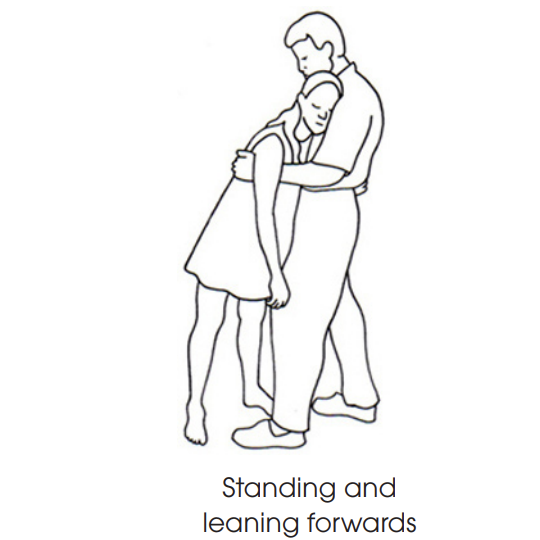
Let’s look at some different positions available for labouring!

-
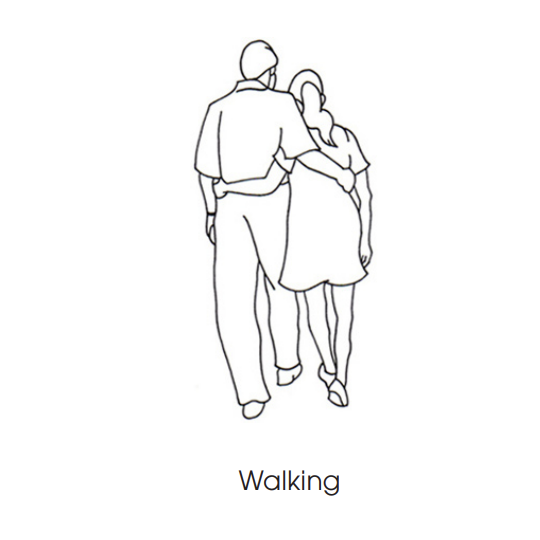
This sounds pretty obvious, but especially in early labour, even just walking around your neighborhood can bring a lot of relief, help you to focus on something else, and keep your pelvis moving so that baby can settle into a good position.
-
Used mostly during active labour when baby doesn’t seem to be engaging, this movement can feel wonderful if you’re experiencing back pain. Perform the lift yourself, or have a partner help by standing behind you. Either way, you will knit your fingers together under the belly, and lift ‘up and in’ during a contraction. Try this for a few contractions in a row if you can.
-
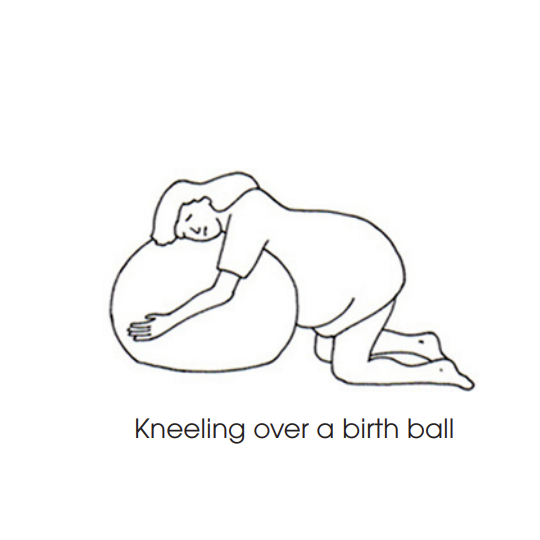
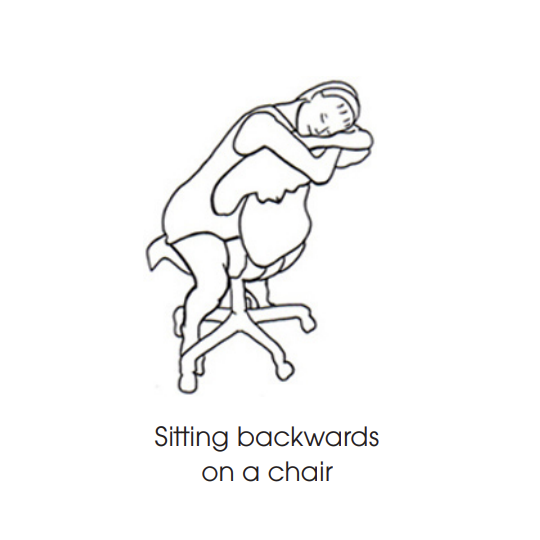
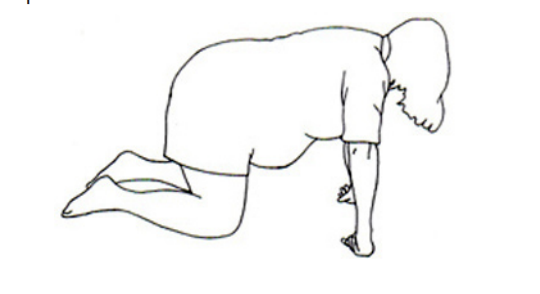
Hands and Knees can be a fantastic option if you are experiencing back labour, or if you’re just needing a bit of a rest. You can also take advantage of this position by leaning over a birth ball or a stack of pillows. This is a great position if you’re needing counter pressure. Bonus marks: Sway your hips back and forth during a contraction to decrease the chances of any tension building.
-
Both the standing or kneeling in bed versions of this movement are fantastic for opening the pelvis and correcting any malposition of baby. Some gentle lunges can also feel wonderful if you’ve been lying or sitting in bed for too long and feeling pain in your sacrum.
-
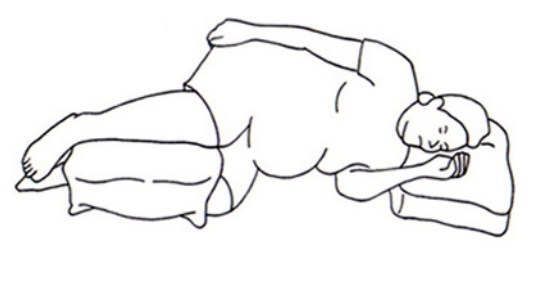
Needing a break but still want to make sure you’re being productive? A well supported side lying position (ideally with pillows or a peanut ball between your legs) allows space in the pelvis while you get your much needed rest!
-
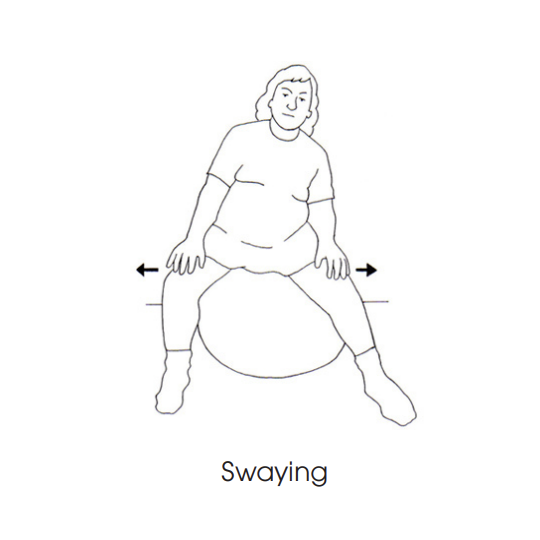
Another great option combining movement with rest! Move your birth ball up to the edge of the bed or couch (with pillows added as needed). You can sway or do hip circles, and also have the option to lean forwards onto the bed during times you feel you can rest.
-
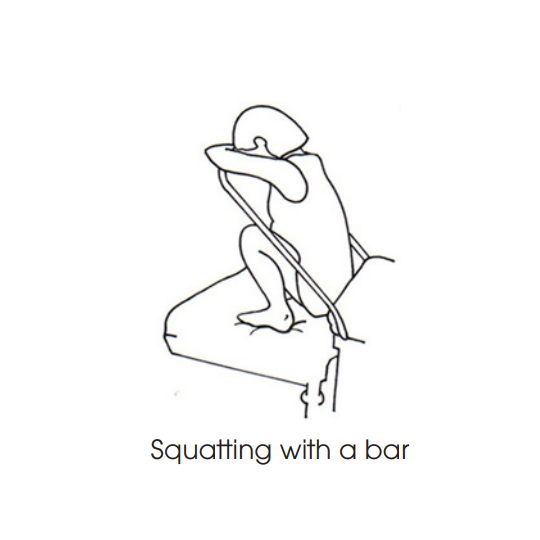
A deep squat is great for opening the pelvic outlet (by up to 28%!) in order to allow baby to move, and can be a great way to use gravity without having to stand. You can squat on your own, while holding onto your partner for support (they can grab your hands, or stand in behind you and grasp under your arms), or even with a squatting bar in a hospital bed.
You can also review Positions for Labour or Positions for Labour and Birth
Last but not least, I wanted to include this great graphic for peanut ball positions. While we mostly use the peanut ball once you’re in bed, it can also be used in place of a yoga or birth ball if you prefer.

Take some time to look through the readings and video above and make your own written or mental list of the things that you want to try during your birth. I would also recommend taking some time to practice them. This can be dedicated time once a week or so, or combine it with other things you’re doing — I still use my labour breathing every time I need to go to the dentist or get a blood draw! You can also work on breathing or a roving body check while you’re in the car.
You may some some techniques are super helpful and others you thought you’d love just don’t do it for you. This is all useful information as we head into labour!
Next up we will examine your pharmacological pain relief options. Remember that even if this is your plan, you’ll want to be able to handle early labour using some of the above options. It’s always good to have a few in your pocket!