
IT’S BIRTH TIME!

But umm… What exactly does that mean?
Don’t worry, we’ve got you covered. To fully understand the stages of labour, I think it’s good to go over what is actually happening behind the scenes while your body works so hard. Read on for everything you need to know about contractions, cervical exams, your water breaking and how we measure progress.
Before we go any further, what IS a contraction? We use the word a lot, but do you understand what is happening?
I talk about how with birth prep we aim to reduce fear by increasing information, and I think that should start with understanding contractions and appreciating how amazing your body is!
A contraction is when your uterus muscle rhythmically tightens and then loosens in order to move the fetus down the birth canal. We think of our uterus and cervix as being different things, but remember that the cervix is just the opening of your uterus and they work together. During a contraction, the tightening muscle exerts force downwards towards the cervix. This pressure helps to dilate the cervix, move it forward where it needs to be, and move the baby down so it can be born.
Watch the following videos for some perspective about what is happening during contractions, and what they can feel like.
Bridget doesn’t use super inclusive language and leans towards an unmedicated birth preference, but she knows her stuff and has a great way of describing these sensations.
Takeaway? Your contractions are YOUR amazing body working so hard to get your baby here. They can feel overwhelming because they can be SO strong. Remember to work with your body and allow it to do that work it’s trying to do.
They are strong because YOU are.

When most people talk about labour progress, they’re referencing how dilated you are. And while this is certainly one way we measure labour progress, it’s important not to forget the other hard work your body is doing. People focus on dilation because it’s easy to track, but there’s actually six ways that we measure labour progress, and every one of these factors works together to get baby into your arms.
Six Ways Labour Progresses
-
This often happens prior to labour and in early labour, but is sometimes still occurring in active labour. For babe to make their way out the easiest, your cervix needs to be facing anterior.
-
Think about objects around you. What moves easier: something rigid, or something soft and mushy? That soft cervix will dilate faster, so this is a great sign of progress! Think of a soft cervix melting away with that contraction pressure, where a hard cervix will provide a bit more pushback.
-
Your cervix starts out as long and thick (like the neck of a ballon!). As it thins out (0-100%), it will also dilate faster and be more likely to want to move as the fetal head descends. This is acalled effacement.
-
At the beginning of labour, your cervix will typically be 0-2 cms open. As labour progresses, it will open up to 10 cm wide to allow baby to pass through.
-
Our bodies and babies truly are amazing. Even if it hasn’t been in the best position prior to labour, your body will work with the baby to move into the position needed for birth. Sometimes this is a slight head tilt, other times your body may work with baby to move them from posterior to anterior.
-
This is referred to as baby’s “Station”. You’ve probably heard people asking “Is the baby engaged?” or “Has he dropped?” During pregnancy a baby is often ‘floating’. That is, they are not settled deep into the pelvis. As birth approaches, a baby will move deeper into the pelvis, feeling awkward, but putting needed pressure on the cervix!
A bit more about “Station”
As you can see in the diagram to the right, fetal descent is marked as ‘stations’ in -3 to +4. Typically when labour starts we hope baby to be closer to engaged in a -2 or so. As labour progresses, baby will engage further. A station of +3-4 means the baby is on the perineum almost here! Looking at this, can you see how much easier it would be to push out a baby who is at a +2 than a -1? This is where that labouring down comes into play!
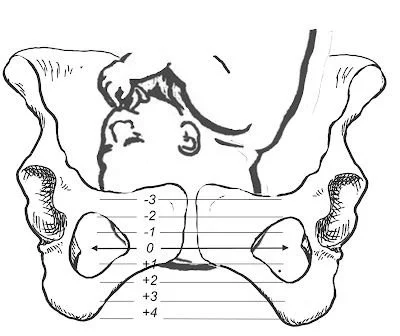
I certainly won’t go as far as Chanel to say that dilation doesn’t matter BUT I agree that it sometimes may not be the most important factor. Knowing where baby is sitting, and how we can help baby get lower, will often be more effective than attempting to force that cervix to dilate. Remember they work together! I love that she focuses on the reminder that your baby’s station is likely a much better predictor of how much longer you have in your labour or how things may progress. This is a great primer to start looking at Spinning Babies and how it may help your labour if babe is seeming higher than we would expect at this stage of labour.
Remember that these factors all work together and dilation happens faster when your cervix is also anterior, soft and thin, with a low baby. So even if your dilation is only a 5, if it is very soft, and 90% effaced, with a very low baby, we know that birth may happen sooner than later. Dilation is great to know, but only one small piece of the puzzle!

Speaking of progress…
Let’s talk about cervical checks.
During a cervical check (also more accurately called a pelvic examination or PE), your nurse, midwife or dr will insert their fingers into your vagina and feel for progress. While they’re often primarily looking for your dilation, a good PE will assess all six factors we named above. A check is typically done in between contractions, but if you are feeling an urge to push, they may also check during the contraction. What they are looking for is to see if the cervix actually dilates more when pressure is applied - often a cervix that measures as 9cm, actually stretches to 10cms once a contraction hits and baby’s head is providing pressure.
Many nurses and doctors prefer cervical checks to be done on your back with your ankes together and knees apart. If you are more comfortable in another position, you can request that as well, or decline the exam!
The frequency of cervical checks is often dependent on several factors. Your birth place, pain levels, contraction pattern and birth preferences will all play into how often you receive a check during labour. In general, you can expect a check once you get to the hospital or your midwife joins you. This baseline check can be important in order to gauge progress later on. Thankfully typical procedure now has moved to subsequent cervical checks being much less frequent than they used to be. This is good because it allows you to fully focus on your labour without disruptions and it allows us to focus more on how you are feeling and what you need than what your official ‘number’ shows us.
Most often now your next check will not come until we need more information to make a decision. I have seen birthers go 12 hours in between checks if they’re coping well and labour is progressing but they don’t seem to be close to pushing yet.
Benefits of Pelvic Exams
An exam may show you that you’ve made more progress than you thought - this can be very encouraging if you’re needing a morale boost, especially in a longer labour!
It can also help you decide what kind of pain relief you want to choose as you may choose different at 4 cms vs 8cms.
Knowing baby’s station and position may provide insight into some good labour positions to try to encourage progress.
If you start feeling pushy, your provider will normally want to do a quick exam just to confirm that there’s no cervix left behind that may swell if we start exerting more pressure on it.
If it has been many hours and contractions aren’t seeming stronger or closer together, then an assessment can also give your team an idea if we need to try something different or augment labour. This is more common with inductions, especially if you’ve chosen an epidural and it’s hard to track your contraction strength.
Downsides of Pelvic Exams
An exam may show you that you’ve made LESS progress than you thought - this can be very discouraging if you’re needing a morale boost, especially in a longer labour!
An exam gives you a snapshot only of that moment - it doesn’t tell us how far away birth actually is. We can only extrapolate a guess based on your prior labour, but it’s just that, a guess!
While precautions are taken, every pelvic exam increases the chances of bacteria entering the vagina causing infections.
Assessments can be wrong, especially if performed by different people. This can be very upsetting if one person says you are further along, and then the next check shows you’re actually not quite there yet.
While very low, there is a chance of an exam rupturing your membranes.
Vaginal exams may be uncomfortable, especially if you have to change positions, which can disrupt your groove.
It’s important to remember that you can refuse a cervical check at any time- or ask to wait until you’re feeling more grounded. Some birthers find the checks overwhelming, others find that they boost their confidence that progress is happening. Trust your gut and remember that we have other ways to assess progress if needed! You should always feel in control of your body.

When Will My Water Break?
Ah, the question on everyone’s mind. While it does sometimes happen before labour starts (my first labour began that way!), typically your waters will break during the first stage of labour after contractions have started. When it does break, if you haven’t moved to the hospital or been joined by your midwives, make sure to note the following:
T ime of water breaking
A mount of water (trickle or gush)
C olour of waters (clear, pinkish or green/brown)
O dor (It should smell neutral or like saline)
If your water breaks at home, you are normally ok to stay there for a bit until contractions pick up. However there are a few things to watch for. If your waters are not clear when they break (a bit of pink is ok) or are accompanied by a strong smell, advise your care provider immediately for further instructions or head into the hospital. If you tested GBS+ during late pregnancy, you should begin to make your way to your place of birth if you are planning to get antibiotics. Another thing to watch for would be feeling something in your vagina without rectal pressure. This would be a potential sign of a cord prolapse which is a true emergency situation. If you suspect a cord prolapse, you should get into a knee chest position and call 911, especially if you can palpate a cord in the vagina.
What if my water doesn’t break?
Don’t worry, your water not breaking early in labour is NOT an emergency. If your water does not break on it’s own during labour, one of three things will happen. It will break during pushing (your provider may don some extra protections just in case!), your baby will be born inside the amniotic sac (known as en caul, and not an issue at all), or your provider may choose to break your amniotic sac at some point during labour or pushing. We will talk about this option later on.

I’m in labour! Maybe…
Everyone wonders how you’ll know when it’s really ‘go time’. Here’s some handy tips to know when your journey has started.
Your Water Breaks - Whether a gush or a trickle, things are starting! Make sure to take note of the things we discussed above. We typically want to see progress starting within 12-24 hours after your water breaks.
You lose your mucus plug or see bloody show. This may happen a few hours or a few days before labour begins. You may notice pinkish or yellowish globs of mucus in your underwear or when you wipe. It usually means there’s small changes happening to your cervix but labour could still be days out.
You feel like you caught a bug. Achy, tired, upset stomach? These can be early labour signs as your hormones shift.
You’ve got a backache that won’t go away. If your back seems to throb for hours on end, this could be a sign of early labour.
And of course, Contractions become more regular. As your rushes go from seeming random and all over the place, to stronger, longer and closer together, we know that these are now early labour contractions, and no longer prodromal (We’ll talk about this next.)
If you notice any of these symptoms, give me a heads up. It could be hours or even a few days, but it gives me a chance to start preparing to be ready for you and we can discuss what your next steps are!
Still feeling a bit unsure? Download this graphic to take with you.